
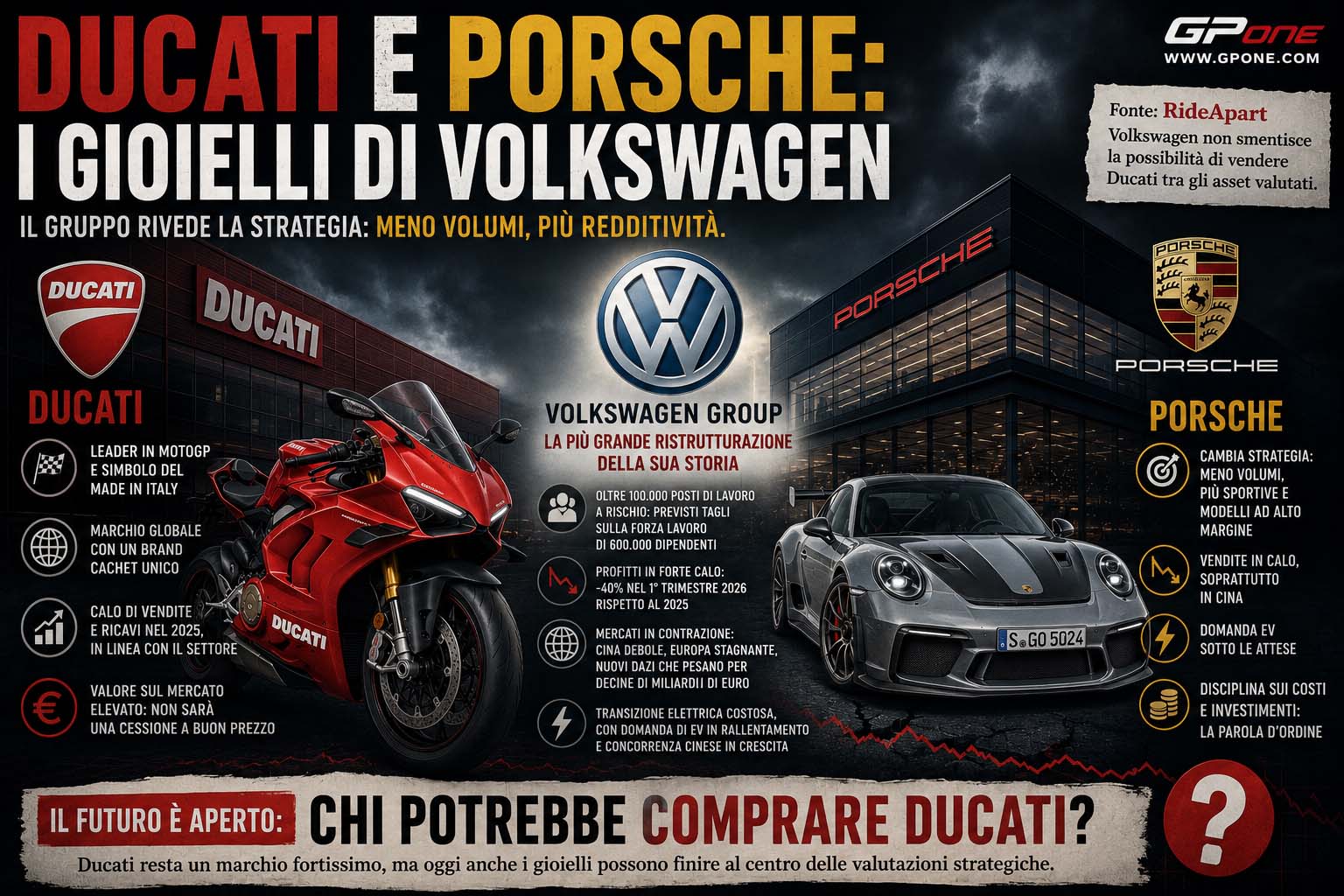
In recent days, we published a story that emerged on the financial markets and was reported by the Financial Times. Today, another report has surfaced from the American website RideApart, which is part of our group.
The question is no longer just whether Volkswagen will sell Ducati, but why this possibility has suddenly become credible.
Following the Financial Times report—which claimed that the Group’s financial advisors had suggested divesting certain assets— RideApart directly asked Volkswagen for an official statement. The German automaker’s response does not confirm the sale of Ducati, but more importantly, it does not deny it either.
To understand the significance of the statement, however, one must consider the current situation facing the Volkswagen Group.
The European automotive industry is grappling with an unprecedented transformation. New trade tariffs, growing pressure from Chinese manufacturers, the contraction of several traditional markets, and lower-than-expected demand for electric vehicles are squeezing margins and profitability. In the first few months of 2026, Volkswagen reported a sharp drop in profits and announced new cost-cutting measures, speaking openly about the need to change its business model.
Against this backdrop, even Porsche—long one of the Group’s most profitable brands—has shifted its strategy: less focus on volume and greater emphasis on high-margin sports models, following a slowdown in sales—particularly in China—and cooling demand for electric sports cars. This decision demonstrates that even premium brands are now required to prioritize profitability and financial discipline over mere growth in registrations.
It is in this context that the statement sent by Volkswagen to RideApart should be interpreted.
"Please understand that we do not comment on internal, confidential documents. The underlying matters will be discussed and approved in the respective committees. We will not pre-empt this process.
It is correct that the entire automotive industry and the Volkswagen Group are undergoing a profound transformation. The Executive Board has repeatedly stated that our current business model no longer works across all brands: developing cars in Germany, producing them in Europe and exporting them to the world.
The world has fundamentally changed in recent years. Over the past twelve months, developments have intensified. New tariffs, harder competition and stagnating – in some cases declining – markets are currently placing burdens on the company reaching tens of billions of euros per year. To remain successful under these conditions, we have to evolve. The entire Group has to become significantly more competitive. That requires a sharper focus as well as stricter discipline over costs and investment. Only in this way can we defend and consolidate our position as one of the world’s leading automotive manufacturers and continue to finance our future by our own means.
The entire Group – including brands and subsidiaries – have to transform profoundly. To that end, the Executive Board has worked intensively over recent months on a future plan for the realignment of the company. The goal is to make the entire company more efficient and leaner and to capture technological synergy potential consistently. In particular, this applies to decision-making processes and structures – especially in the development and integration of new technologies as well as in the model portfolio for our customers.
In the next step, this comprehensive transformation is to be implemented following the Supervisory Board’s engagement."
The most interesting part, however, is what is missing. In its lengthy statement, Volkswagen never says that Ducati is not for sale. On the contrary, it reiterates that all of the Group’s brands, without exception, will have to prove themselves to be more competitive, more efficient, and more profitable.
For this reason, the possibility of selling the Borgo Panigale-based manufacturer can no longer be dismissed as mere market speculation. Ducati remains an extremely strong brand, a leader in MotoGP and with a unique image in the motorcycle world, but today even a gem of this caliber could find itself at the center of strategic evaluations by a Group that is undergoing the most profound reorganization in its history.
Whatever happens, there remains the satisfaction that a deeply Italian company like Ducati—owned by VW, but with management and production rooted in Borgo Panigale, whatever anyone may say—is considered a flagship, both technologically and in the marketplace, for a group like VW.