
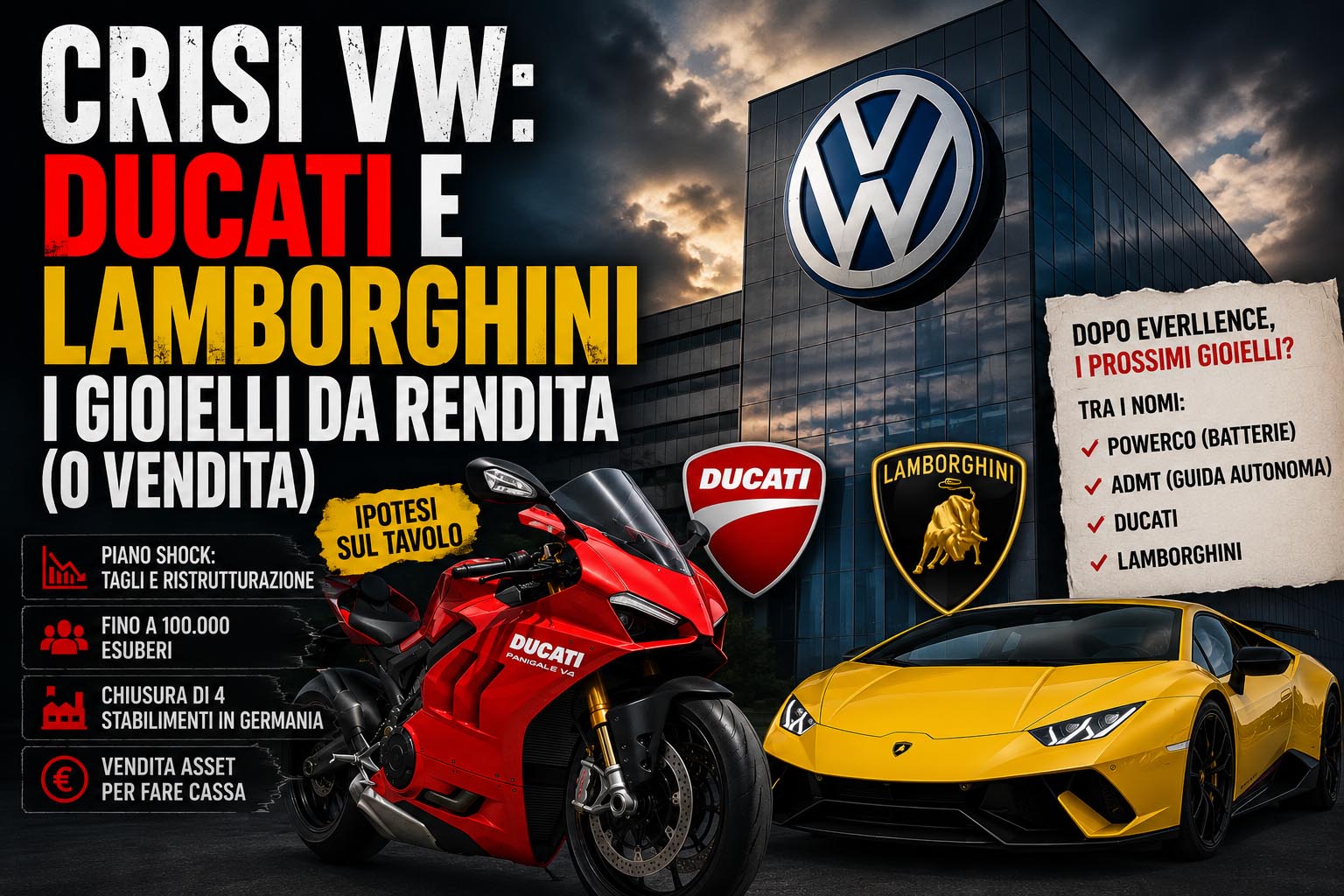
Every time Volkswagen enters a phase of major restructuring, one name inevitably resurfaces: Ducati.
It happened in 2017, when the German group considered selling the Borgo Panigale-based manufacturer but ultimately backed down in the face of internal resistance. It’s happening again today, as Volkswagen faces one of the most delicate moments in its recent history.
According to a report in the Financial Times and reported in Italy by Milano Finanza, the group led by Oliver Blume is reportedly preparing a new phase of its reorganization plan following the launch of the sale of its marine engine division, Everllence (formerly MAN Energy Solutions), valued at 10 billion euros. This move has reignited speculation about the group’s other “valuable” assets.
Among these, inevitably, is Ducati.
No decision has been made
It’s important to clarify this right away: there is no official announcement indicating an intention to sell Ducati. But of course, it’s being discussed just like the Group’s other companies: PowerCo (batteries), ADMT (autonomous driving), and Lamborghini.
Rumours instead point to a broader reevaluation of the Volkswagen Group’s structure, as the Group is under pressure to cut costs, finance the transition to electric vehicles, and regain competitiveness, especially against Chinese automakers.
In recent months, management has accelerated its efficiency programme, announcing thousands of voluntary departures, reductions in production capacity, and a restructuring of the industrial organization.
According to data released by the group itself, Volkswagen alone plans to reduce its workforce by approximately 19,000 employees by the end of 2026, while the overall plan also involves Audi, Porsche, and Cariad. The measures aim to restore profitability in an increasingly competitive environment.
Why Ducati, of all companies?
The answer is simple: because it represents one of the group’s most valuable assets.
Unlike other industrial operations, Ducati remains a premium brand, with a strong identity, extraordinary racing achievements, and high profit margins.
Precisely for this reason, a potential sale could generate significant proceeds, which could help finance part of the German giant’s restructuring.
It’s the classic paradox: Ducati isn’t being discussed because it’s in trouble, but because it’s worth a lot. It’s a scenario that resurfaces periodically. It wouldn’t even be news.
As early as 2017, Volkswagen seriously considered selling the Borgo Panigale-based manufacturer. The deal did not materialize, partly due to the influence of employee representatives on the group’s Supervisory Board, who have historically opposed the sale of assets considered strategic.
Today, however, the context is different. Competitive pressure from Chinese manufacturers, the massive investments required for electrification, and the need to improve profitability are forcing Volkswagen to make choices that seemed unthinkable just a few years ago.
Ducati and Lamborghini: Different Fates
Analysts’ analyses often group Ducati and Lamborghini together, but the two situations are not identical.
For Lamborghini, the main topic of discussion continues to be a possible IPO modeled after Porsche AG in 2022, while maintaining control of the brand.
For Ducati, on the other hand, the most common scenario remains that of a full-scale sale.
However, at least for now, these are merely scenarios developed by financial observers.
The Real News
Irrespective of the rumours, the most significant fact may be another.
Ducati has returned to the spotlight not because it poses a problem for Volkswagen, but because it is considered one of the group’s most valuable assets.
And this is precisely why, every time there is talk in Wolfsburg of raising cash, the name of the Borgo Panigale-based manufacturer invariably resurfaces among the possible pawns in a game that, at least for now, is still wide open.
Sources: Financial Times (reconstruction taken from Milano Finanza), Milano Finanza, Quattroruote.