
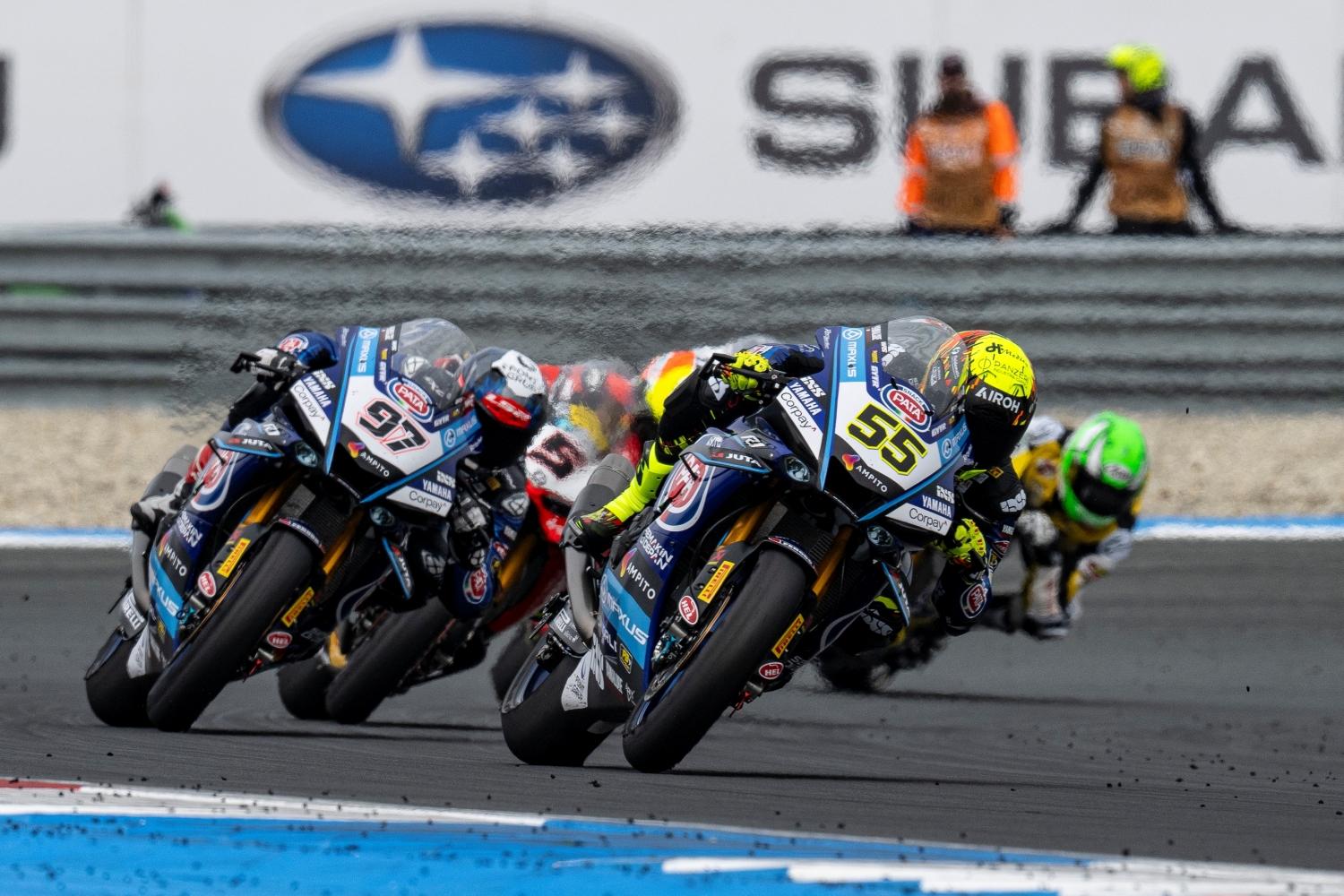
After a stopover at Misano to watch the final race of the CIV Superbike season opener up close, Niccolò Canepa headed to Balaton Park for the fourth round of the World Championship, taking with him several ideas to consider for the future. In a chat with our correspondent Riccardo Guglielmetti, Yamaha Motor Europe’s Road Racing Sporting Manager made no secret of the fact that he was very impressed by the path taken by the Italian Championship.
“My presence at the CIV wasn’t planned since I handle Superbike and Endurance, but when I saw the full grid on Saturday and Delbianco’s victory, I got in the car and drove to Misano. I’m very pleased that the rule change has led to a full grid, with nearly 40 bikes at the start. It’s wonderful to see, because it means that by lowering the technical barrier and making the championship more accessible to everyone, you end up with a very interesting championship,” he noted. “Even in terms of balance, despite it being the first race, I saw four manufacturers battling it out up front. Having many manufacturers capable of performing well and a large number of bikes on the grid is exactly what we need, and I decided to go to the CIV precisely because I found it interesting to follow and also quite enlightening regarding the future of this championship, given that the bikes used are production-based and intended for public sale.”
It was a triumphant first round for Yamaha, which secured a one-two finish with Alessandro Delbianco.
“I’m very happy. I know his worth very well, since he’s our test rider and he’s done something exceptional. He, Yamaha, and the team have been fantastic; they’ve put together a package that works really well, and I’m pleased to see how the R1 is still competitive in so many championships: we’re first in MotoAmerica; in BSB, which starts this weekend, we’re the defending champions; we won the 24 Hours of Le Mans with YART and two races in the CIV. These are positive signs, which we need at Yamaha,” commented the former rider from Liguria, who did not want to delve too deeply into the controversy raised by Michele Pirro.
“I have deep respect for Pirro and for what he’s achieved in his career, and I know that for a rider it can be difficult to express himself clearly right after a race, when the adrenaline is pumping through your veins. I understand his point of view, but I also think that in both races Rinaldi’s Ducati was up front, which makes me think the bike is competitive,” he noted. “I don’t know why Michele wasn’t able to get 100% out of his package this weekend, but I believe that if Rinaldi had finished the races, perhaps he and Delbianco would have each ended up with a win. Just as we’d expect from a hard-fought and balanced championship. As for the fact that Delbianco’s bike isn’t stock, I don’t think any of the bikes racing there are. As the championship regulations stipulate—it is, after all, called Superbike.”
Why is Yamaha so strong in the CIV but going through such a tough time in the World Championship?
“There’s a combination of factors, and if we look at Assen, we’re going through a tough time just like four other manufacturers. Even though we finished seventh, in fact, I can’t complain because our race went better than that of other manufacturers participating. It’s clear, however, that in other races we’ve struggled more,” replied Canepa. “I’m curious to see what we’ll be able to do here at Balaton. We’d be happy if we could match our performance from Assen, keep improving, and leave a few more privateer bikes behind us. What I’ve noticed is that some regulations adopted in national championships are more balanced than those in the World Championship. This isn’t meant to be a criticism, but it could be food for thought regarding the direction we should take in the future: perhaps the goal shouldn’t be more horsepower or higher top speed, but full grids and hard-fought races.”
Another aspect to consider is the reduction in performance.
“We need to ask ourselves how it’s possible that at Assen, the last race we had, the total race time improved by 30 seconds compared to two years ago and by more than 20 seconds compared to last year, despite fuel flow decreasing year over year and this year’s tyres being harder than in 2025. Since the goal is to reduce performance, we actually need to take action to do so, because right now we’re not doing it the right way,” said Niccolò. “It’s true that we were a little faster than last year, but the performance that earned us the win in 2025 only got us 7th place this year. We need to find a balance so that the step forward from one year to the next isn’t so big but remains consistent, if we don’t want to slow it down.”
When asked what he would bring from CIV to the World Championship if it were up to him to rewrite the regulations, the Yamaha manager replied: “It’s hard to say, because there are the interests of many manufacturers involved, and to have a healthy championship, we need to find a compromise that makes everyone happy. There are, however, things that can certainly be improved. Such as perhaps giving more manufacturers the chance to enter the championship, opening it up to bikes with different engine capacities like the Aprilia or the Ducati V4 S. I believe moving a bit in the direction of Supersport could be the right solution to make this championship a bit more accessible, reduce costs a bit, and have a fuller grid where everyone is competitive. I believe this is what we should aim for in Superbike as well, and that it’s also Dorna’s goal, because nobody likes to see a single manufacturer dominating.”
Gone are the days when Yamaha, Ducati, and Kawasaki battled for victories and the title with Toprak, Bautista, and Rea.
“In my opinion, it’s now important to restore the balance that existed back then, and the only way to do that is through regulation changes. A single ECU could be the solution, or we might need a Balance of Performance system like the one in Supersport, which allows bikes with different philosophies and engine capacities to share the grid, be competitive, and fight for victory. Always rewarding the best, because in sports the best package must always win,” he underlined. “This is something we need to be mindful of, and it happens in Supersport, where we won last year with Manzi because I believe we had the best rider, the best team, and the best bike. This is what should happen in Superbike as well, closing the gap a bit and giving other manufacturers the chance to be competitive. Also because the World SBK Championship is the only series where electronics are unrestricted, and this obviously affects costs, as a result leading to an increase.”