
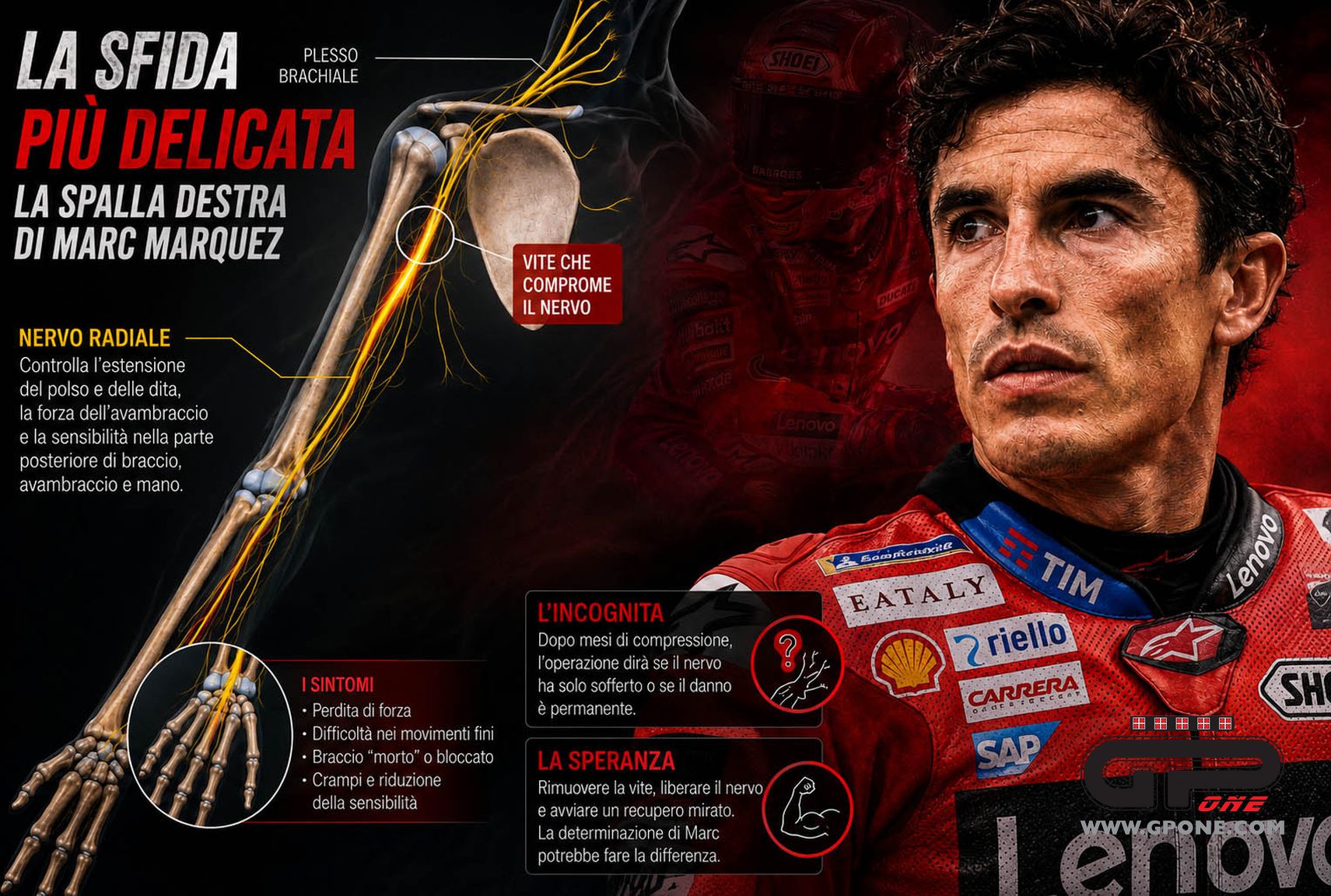
Marc Márquez is preparing to face what may be one of the most delicate challenges of his entire career. Behind the scheduled surgery on his right shoulder lies not only the need to remove a screw that, as the rider himself explained, was pressing on the nerve. Above all, there is the uncertainty surrounding the condition of the nerve itself after months of compression.
According to reports from within the Ducati camp, the situation is much more delicate than it initially appeared. The feeling is that the nerve may have suffered prolonged damage over time and that the surgery could lead to two completely opposite scenarios: on the one hand, the possibility of definitively resolving the problem; on the other, the risk that the neurological damage has left permanent consequences.
The central issue is precisely this: understanding how long the nerve remained compressed by the displaced screw following the collision caused by Bezzecchi in Indonesia. In such cases, compression can lead to a progressive loss of strength and sensation, especially in the flexion and closure movements of the thumb, index, and middle fingers—deficits typical of neurological damage in the proximal part of the arm or forearm.
The anatomical image of the radial nerve helps to better understand the problem. The nerve, highlighted in yellow, originates from the brachial plexus at the shoulder, runs through the entire arm and forearm, and extends all the way to the hand. It is one of the main nerves of the upper limb and controls most of the strength and sensation in the thumb, index, and middle fingers—precisely the fingers essential for braking, throttle control, and handling a MotoGP bike at the limit.
In Márquez’s case, the screw may have caused intermittent compression of the nerve in certain positions of the shoulder and arm. This would explain why the rider felt relatively well in daily life or during motocross training, only to experience a progressive worsening once he got on the MotoGP bike, where the arm is extended far forward and subjected to constant stress.
From a medical standpoint, prolonged nerve compression can cause loss of strength in the hand and forearm, difficulty with fine motor skills, a “dead” arm sensation, cramps, and reduced sensitivity. And that is precisely what Márquez had described in recent months, speaking of a “strange” sensation, of an arm that was gradually ceasing to respond to him.
And this also explains the unusual behavior he exhibited on the track: the strange crashes, the inability to react in duels, that feeling of inconsistent riding that he himself had confessed to without initially being able to understand the cause.
Paradoxically, however, the fact that the problem occurred mainly while riding also leaves open a positive possibility: that of intermittent, rather than continuous, compression of the nerve. If this were the case, the neurological damage could be limited or even reversible once the mechanical cause is eliminated.
And that is why the surgery will be decisive. Removing the screw will mean freeing the nerve and determining whether full function can be restored. Much will depend on how long the nerve has been compromised and how it reacts once the compression is eliminated.
In this sense, Márquez’s almost obsessive determination could become a major asset. Neurological recovery is, in fact, aided by continuous neurophysiological stimulation, training and specific exercises. And few riders in history have demonstrated the ability to endure pain, fatigue, and rehabilitation like Marc.
The real question mark, however, will not be solely physical. As is often the case with neurological recovery, patience and mental balance will be required. Because the brain, too, will need to learn to trust the right arm completely again.
The coming weeks will be decisive. Only after the surgery and with the passage of time will it be clear whether Márquez can fully regain the strength needed to ride a MotoGP bike at the limit, or whether this time his career will face its toughest challenge yet.