
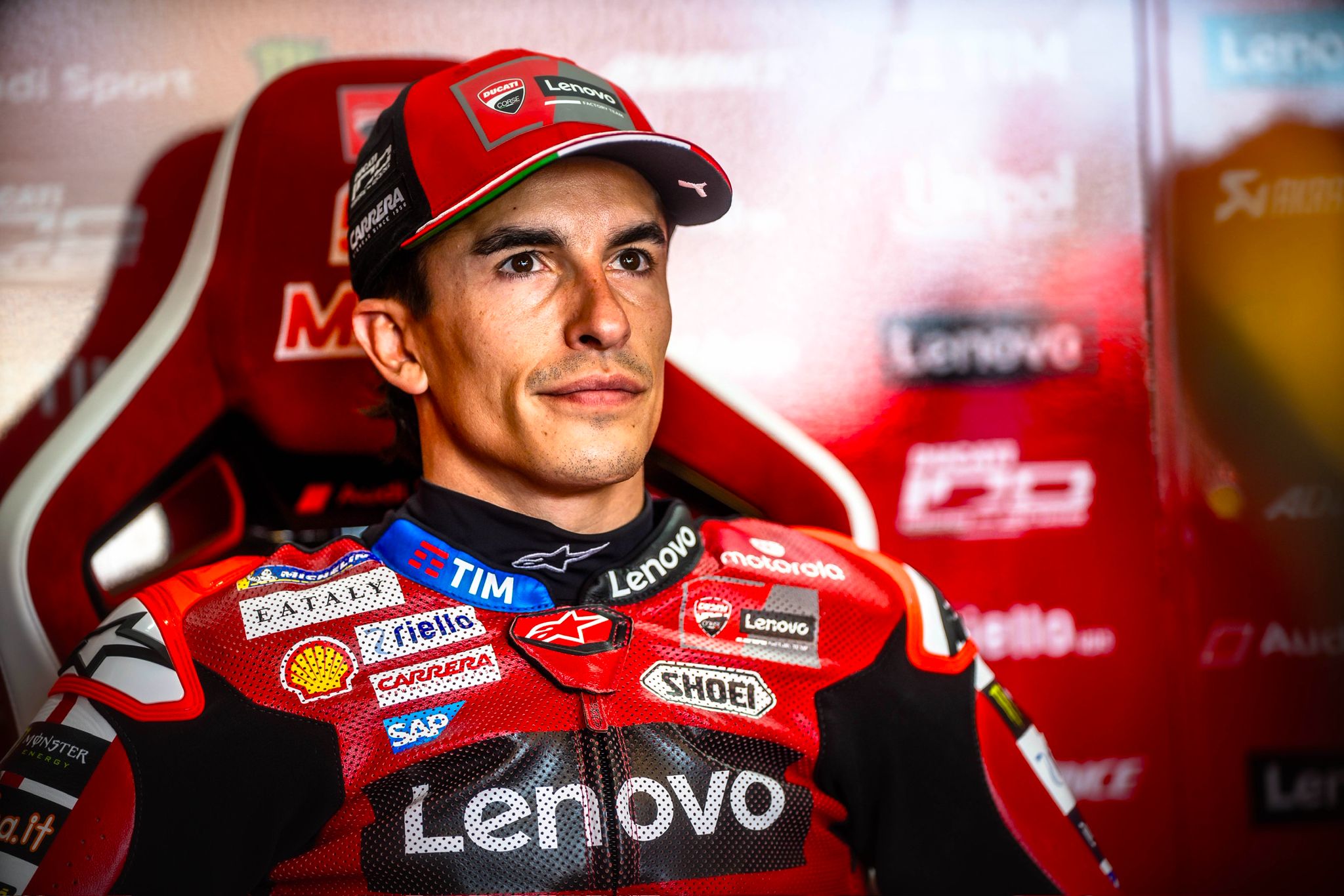
Marc Marquez is trying to “survive,” in his own words, the Assen Grand Prix. It’s a track he doesn’t like, and he can’t afford to take too many risks there right now. Today he finished 6th in pre-qualifying, but he also had a crash this morning (“It was my mistake”). Q2 is still a sure thing, though.
He sees the Aprilias as favorites and doesn’t hesitate to put a little bit of pressure on Bezzecchi: “If he doesn’t manage to score 37 points… He should score 37 points,” he said slyly.
Let’s talk about your day.
“The goal was to finish in the top 10, and when I saw I had a decent time, I stayed in the pits. Tomorrow is another day; I realized right away that on this track—where I usually struggle—it’ll be a bit tougher this year. We just have to survive.”
Why do you struggle on this track?
“The direction changes are too quick and it’s too narrow; even a small mistake can cost you dearly. I don’t feel comfortable riding here, but I’m riding well, especially in the first sector; in the others, I’m not having fun. It’s one of those tracks where you have to be very careful.”
Did the heat contribute to the many crashes?
“When it’s cold, it’s harder to find the limit, while the heat gives you more confidence but there’s less grip. We saw a lot of crashes in Moto2 and even in MotoGP. I prefer the heat to the cold.”
You don’t seem to like Assen very much…
“I don’t want to say I don’t like it… but I don’t like it (laughs). I’ve won races here, but it’s a very fast and tight circuit, and the run-off areas are full of gravel—really coarse gravel. It’s one of the tracks where I hope it rains, but it doesn’t look like that’s going to happen this year ( laughs). I’ll try to survive. I like the track layout, but not the risks you have to take. We’re professionals, and you can’t love all 22 tracks—we have to give it our all.”
What about taking risks?
“There are spots where you push it; I did that this morning and crashed, but it was in a slow corner (laughs). Last year, on Friday, I crashed in two fast corners. I know that tomorrow I’ll have to take some risks if I want to finish in the top 6.”
Did you talk to your brother Alex after the crash?
“I saw him; he didn’t break anything, just pain all over his body. He was going a bit too fast (laughs). It’s hard for a rider to control his instincts.”
What do you think about starting without the lowering device?
“There are two aspects to consider,” he explains. “From the start to the first corner it’s more dangerous, but under braking it’s safer. I tried four practice starts, and in two of them I reached the first corner with the front wheel off the ground. In a practice run, it’s easy—you just need to ease off the throttle—but in a real start, with all the bikes, who’s going to do that? It’s normal, because when you can use the rear lowering device, the rear end is very low. The braking point feels more natural, but something could happen before you get there. It happened about ten years ago in Barcelona, when someone ran into me, and if I hadn’t been there, he would have crashed into the wall. It could easily happen again. I mentioned this problem, but they decided to go ahead with it, and we have to adapt.”
Should the rear lowering device also be banned at the start?
“It’s impossible because they can’t control it. We use that system not only at the start but also during the race, so it would be easy to take advantage of it.”