

There is a revolution in MotoGP that isn’t visible to the naked eye. It doesn’t make a sound, it isn’t marked by a last-brake-point pass, but it is measured in numbers, graphs, and airflow. It is the revolution of the aerodynamic slipstream—that invisible world that forms behind the rider and has now become one of the most critical areas of technical development.
It hasn’t always been this way, even though “slipstream” is often used as a synonym—a trick to facilitate overtaking. Since the 1970s, massive tail sections have been studied to connect the rider’s rear to the seat.
For years, aerodynamics was synonymous with wings, fairings, and front-end downforce. Today, that’s no longer enough. Teams have realized that the real leap in performance happens behind the bike, where the air no longer flows in an orderly manner but breaks apart, twists, and loses energy. That’s where drag is created; that is where part of the stability—and, increasingly, traction as well—is determined.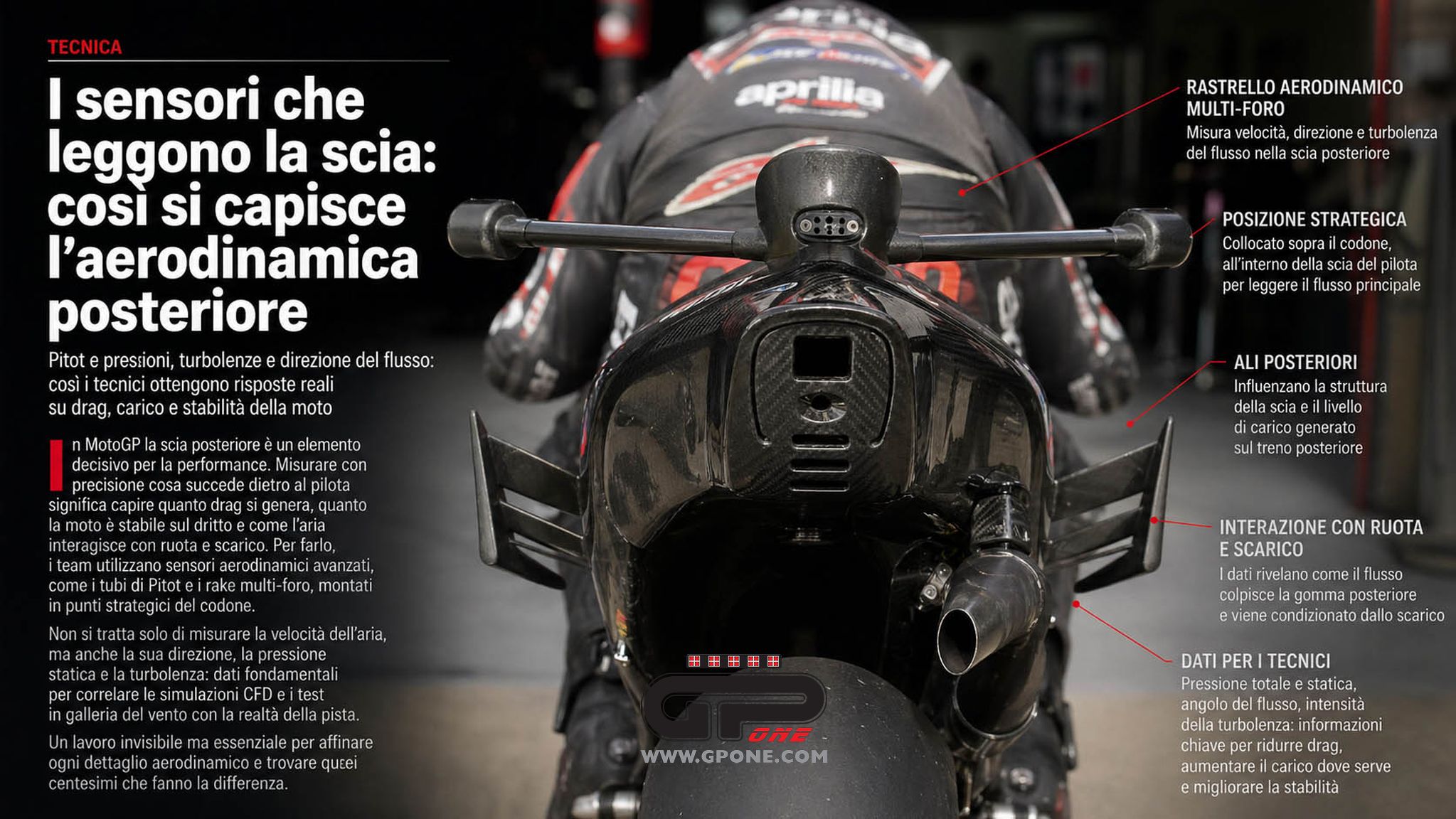
From the visible to the invisible
What until recently was considered a “side effect”—the slipstream—has become a subject of study in its own right. Behind the rider and the tail section, a low-pressure zone forms, filled with vortices and turbulence. If this wake is wide and disordered, the bike pulls enormous drag behind it. If, on the other hand, it is compact and controlled, the gain is immediate: more speed, more stability, more efficiency.
This is where increasingly sophisticated tools come into play, such as multi-hole aerodynamic probes, an evolution of the classic Pitot tubes. Mounted above the tail section, right within the rider’s wake, these sensors do more than just measure airspeed. They also read the direction of the flow, the pressure, and the intensity of the turbulence. In other words: they tell us what’s really happening behind the bike.
Sensors that read the airflow
Their position is no accident. Above the tail section, in line with the rider, they are located at the heart of the wake—the point where all the aerodynamic effects generated by the front wings, fairing, rider position, and rear elements converge.
The data collected is invaluable: total and static pressure, flow angle, and rapid variations related to turbulence. This information is then compared with CFD simulations and wind tunnel tests.
This is where a crucial battle is fought: the correlation between theory and reality. Because you can simulate all you want, but it’s only on the track that you truly discover how the air behaves.
Drag, grip, and stability: it all comes down to that. Understanding the wake means focusing on three key areas:
Drag: a tighter, more orderly wake reduces drag and increases top speed.
Rear grip: airflow directly influences the tyre, changing its behavior during acceleration.
Stability: a “cleaner” wake makes the bike more predictable, especially on the straights.
It’s no coincidence that today so much work is done on seemingly minor details: the shape of the tail, the edges of the fairings, the small rear appendages. Every surface has the task of guiding the air, shaping the vortices, and “drawing” the wake.

The New Frontier
True innovation is no longer just about generating downforce, but about controlling the airflow as a whole, from the bike’s intake to its exhaust. It’s a paradigm shift: aerodynamics is no longer something that “pushes down”, but something that manages the energy of the air.
In this scenario, the slipstream is no longer a problem to endure, but a tool to be utilized. And whoever manages to control it better has a real, measurable, repeatable advantage.
A silent revolution
You can’t see it, but it’s there. You can’t hear it, but it makes all the difference.
Modern MotoGP races there too, in that invisible zone behind the rider where the air breaks apart and reforms.
And it is precisely in that slipstream that the tenths of a second worth a race are hidden today.