BMW and MotoGP: Just plans and promises, No action
THE BACKSTORY - The German Factory has had the opportunity to enter the premier class several times in the past, but has never taken advantage of it. Even today there is (still) nothing concrete
It took BMW ages and close to 500 million Euros in the World Superbike Championship until they finally got the upper hand in 2024 and managed to beat the competition – thanks to the great Toprak Razgatlioglu. For many years BMW showed a lack of passion and professionalism, dilettantism reigned. For a long period of time BMW Motorrad were downright unbeatable in one discipline: How can you successfully avoid winning the title for years with the biggest budgets and the most pointless concepts?
We remember: The top level management of BMW Motorcycles actually wanted to enter the MotoGP World Championship already around 20 years ago. But Berthold Hauser, head of BMW racing at the time, praised the Superbike World Championship as an inexpensive and sensible alternative. It would «only» cost 13 million a year, he calculated. He held out the prospect of an annual budget of 38 million euros for the MotoGP World Championship and knew the cautious board of directors at BMW would never approve such a budget. As there no racing department existed at BMW Motorrad, an expensive five-year deal was agreed with the Bavarian alpha Racing owners Sepp Hoffmann and Sepp Meier.
BMW entered SBK with Troy Corser and Ruben Xaus in 2009 for the first time. The responsibilities were never clearly defined; there was discussion, debate and argument from day one. Managers like Davide Tardozzi came and went. Despite the many millions, the alpha Racing duo from Stephanskirchen did not accept any influence from the BMW headquarter in Munich, where even less racing expertise was available than with the former IDM squad.
Well, after all, in the 1980s BMW had mercilessly ironed out the poor competition with the 600 cc single-cylinder bikes for years at the Dakar Rally with the 1100 cc two-cylinder boxers and the most expensive riders in the world. A heroic deed. Even the BMW Boxer Cup, which was held at some European Grands Prix for years without and decent promotion, could not really help the white and blue bikes to achieve a sporting image, just as little as the Pikes Peak win with the big 1100 cc Twin against a weak-armed single cylinder Rotax privateer bike.
So for five years, from 2009 to 2013, a BMW factory team was involved in the Superbike World Championship. However, five years is a long time for BMW in motorcycle racing, so the Superbike World Championship commitment was outsourced to BMW Italia at some point, and from then on things went downhill.
Hendrik von Kuenheim, Managing Director of BMW Motorrad, then openly flirted with the MotoGP World Championship because he realized that the Superbike World Championship would always remain a sideshow. Even before that, BMW managers such as Herbert Diess and Peter Müller had repeatedly thought about participating in the premier class. But there were only haphazard concepts such as the three-cylinder 990 cc machine at Oral Engineering in Italy. Up to 30 million Euros were wasted for that prototype. The cost was never approved by the board of directors. Luca Cadalora was hired as a test rider. But the car engineers like Mauro Forghieri and Franco Antoniazzi of Oral (based at Modena) had no clue about motorcycles. So the chain drive was on the wrong side, the powerband was as narrow as with Formula One engines. Cadalora was reported of saying: "I don’t know why this bike has a throttle. An on-off-switch would have been sufficient."
Von Kuenheim even appeared at the Qatar GP in 2011 and sounded out the possibilities of a MotoGP entry in talks with Dorna boss Carmelo Ezpeleta, who had already been promised entry by Herbert Diess on December 21, 2005, when the displacement was reduced from 990 to 800 cc for 2007. But nothing ever happened. Ezpeleta felt betrayed. When, despite repeated assurances, BMW then entered the Superbike World Championship of all things, Flammini's rival series, which has only been under the wing of Dorna since 2012, the Spaniard was seething that approach with anger.
Claiming Rule BMW: Nothing came of it either.
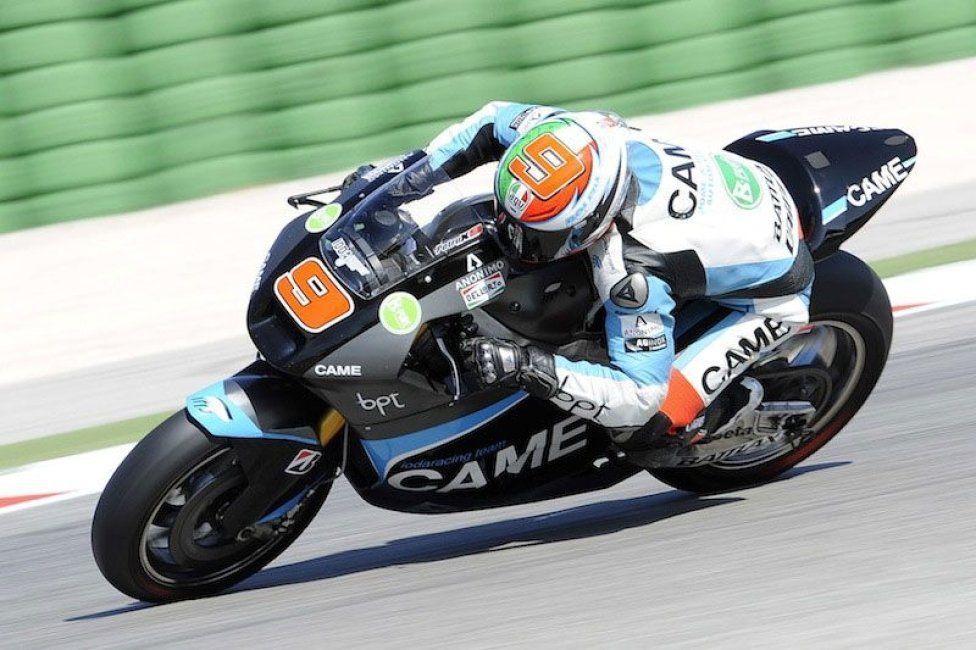
The faint hope that the delicate little plant of the BMW Claiming Rule project could gradually develop into a white and blue MotoGP entry for 2012 also proved to be flimsy. Italian IodaRacing team owner Giampiero Sacchi used Suter BMW machines in the MotoGP World Championship in 2012 and 2013 with riders Danilo Petrucci and Lukas Pesek. It was a custom-built chassis from Suter Racing Technology with superbike racing engines from BMW. After discussions with Berthold Hauser, Sacchi was convinced that BMW would gradually enter the MotoGP World Championship as a factory with him as the spearhead. He hoped to obtain the latest development stage of the BMW Superbike racing engines for 2012 and 2013.
In 2014, the BMW four-cylinder engines were supposed to produce 245 hp instead of 232 hp. Typically for the half-heartedly BMW approach to racing: Marco Melandri had a great chance to win the 2012 SBK title for BMW. But the Bavarians announced their SBK withdrawal for 2013 during the season – and the results went downhill.
It was said at the time that the next step for BMW SBK would be to give the in-line four-cylinder engine of the S1000RR the next power boost to 260 hp thanks to pneumatic valves. The corresponding pneumatic valve technology was sufficiently available at BMW from the Formula 1 era. In Munich, BMW Motorcycle boss Stephan Schaller and Dr. Christian Landerl, Head of Series and Development, were then to set the political course for the official MotoGP entry and give the go-ahead for the design and development of a 1000 cc prototype engine with 260 hp or 270 hp. The Swiss company Suter Racing Technology could have taken over the development of the rolling chassis. But one more time BMW got cold feet.
During the 2015 season, BMW could then have competed in the premier class with a factory entry, at the same time as the other newcomers Suzuki and Aprilia. By that time MotoGP slots were available – like for KTM factory in 2017. But Aprilia decided to agree to a joint venture with Gresini and use his infrastructure and his slots for 2 riders for the first 7 years. BMW CEO Stephan Schaller, who also ended the Husqvarna debacle for BMW and sold the brand for peanuts to KTM, put a stop to all of the factory's sporting activities in 2012, and after that the focus has been on grassroots sport, whatever that meant. World Endurance Championship for example.
Is this motorsport that the masses are not aware of? Motorcycle sport at the highest level has been avoided wherever possible at BMW Motorrad for decades. Hendrik von Kuenheim is said to have made his entry into MotoGP dependent on a clear premise: MotoGP should not cost more than the Superbike World Championship. A ridiculous approach. That would be like a soccer club only moving up to the first division if it could maintain its second division budget.
Follow
BMW's MotoGP project: It should ideally cost nothing.
Von Kuenheim approached Red Bull in 2011 and asked Didi Mateschitz for 10 million euros for a MotoGP main sponsorship deal. There was no tangible concept form BMW for the upcoming 1000 cc MotoGP category which started in 2012. No constructor, engineers, no rider, no racing department, just a fervent desire for a pittance in the amount of 10 million from the Energy drink giant in Fuschl. The catch: Red Bull could have joined any existing top factory team for that amount of money.
In the past, I often wondered about BMW's strange approach to sporting activities. The fear of losing always prevailed while rival KTM became Europes biggest motorcycle manufacturer by believing in the slogan «Ready to Race». KTM CEO Stefan Pierer is an entrepreneur who lives up to this description. He has purchased brands like Husqvarna, GASGAS and the majority of MV Agusta Motor S.p.a. In the meantime it had become obvious: At BMW Motorcycles, the focus was on profit optimization, the sport was absolutely secondary.
At BMW Motorcycles managing directors come and go every three or five years. If they don't make any serious mistakes during this period, they are promoted to better-paid car jobs like Diess and all the others. Schaller moved to the Voith Group on April 1st in 2018, where he already sat on the Shareholders' Committee. At least a BMW factory team returned to SBK a few years later. For 2021 the BMW family in the FIM Superbike World Championship (WorldSBK) grew by hiring two BMW satellite teams – the Italian Team RC Squadra Corse and Team Bonovo Action from Germany. Both teams used a BMW M 1000 RR bikes. This meant: The BMW M car racing department helped supported the project for the first time by building a competitive engine.
By the way: Former BMW SBK racing boss Bernhard Gobmeier at one stage wanted to design a BMW Moto3 GP bike in order to train the engineers for a later MotoGP entry. But his plan got dismissed in 2012.
The low key BMW comeback of 2017 in the Superbike World Championship revealed poor results for some years. The Germans used the Milwaukee team which left for Aprilia after just one year, but Genesio Bevilacqua's Althea team remained. But also the Italian was flirting with a switch to Ducati or Yamaha. BMW had not achieved a podium finish since 2013, and the Bavarians only fifth in the 2017 World Constructor’s Championship behind Kawasaki, Ducati, Yamaha and Aprilia. Just ahead of MV Agusta, who only had one rider at the races.
For years, BMW had the undisputed most powerful machine in the Superbike racing scene with the S1000RR, as shown by its many successes in national championships. However, only Yamaha, Ducati, Aprilia and Kawasaki have won the World Championship since 2009. Only now BMW is set to win the Superbike World Championship – more than 15 years after their first attempt. Now BMW is leading the World SBK Championship. And for about the 6th time in 20 years they are discussing about a possible MotoGP entry.
Podcast
When Suzuki announced their withdrawal from MotoGP in 2021 the Dutch BMW Motorrad Motorsport Director met with Carmelo and Carlos Ezpeleta in Madrid. BMW could have purchased alle hard- and software and technical knowhow of Suzuki Ecstar including Project leader Shinichi Sahara. But the cold feet syndrome prevailed once more.
Now BMW talks about entering MotoGP in 2027. Nobody should be surprised by the plan of Dorna not to supply BMW with two MotoGP slots. The Bavarians would have to join a satellite team. But up to now at BMW Motorrad a racing department is non-existant – after more than 15 years! And it is hard to imagine that a top satellite team like LCR, Trackhouse, Tech3, Pramac, VR46 or Gresini would switch to the German brand. Any private team owner would have to fear after every engine failure that BMW would pull out of the series with immediate effect.
Carmelo Ezpeleta was manager of the Jarama Circuit near Madrid before he joined Dorna for 1992. He remembers the history of BMW in F1 with changing partners and projects like Brabham, Talbot, Megatron, Arrows, Benetton, Ligier, ATS, Williams and finally Sauber (from 2006 to 2009). BMW withdrew from F1 when the 1400 HP turbos were banned in 1988 – and returned in 2000 with Williams and was winning Grands Prix in 2001. BMW only became an official F1 constructor in 2006 after two spells as an F1 engine supplier. The first, in the 1980s, saw it break ground with the first turbo engine to power a driver to world championship success in 1983 with Nelson Piquet.
For Carmelo Ezpeleta, the Spanish Dorna CEO, BMW so far has been very much of a lost cause for MotoGP – for many reasons. Only the «Official Cars»-Deal has been a perfect match for more than 25 years.